
History of the race
We are very proud to welcome you to the Framar Grand Prix, the second oldest track cycling race in the world. The first was the Paris Grand Prix, which was held for the first time in 1894, followed by Framar and then others, led by the Copenhagen Grand Prix (1941). The fact that only 10 world champions (Tkáč, Vymazal, Kučírek, Hübner, Schmidtke, Schulze, Morelon, Cahard, Gonzato, Quintero) out of 20 participating champions and 6 Olympic winners have been recorded as winners here testifies to how exceptional and high-quality this cycling event is… We believe that others can do it too. Certainly in the Czech jersey.
“New generations are constantly coming in, older competitors are leaving, young people are coming in, as is the case in every sport. Performance levels rise, successes come, technical innovations appear, rules change. But one thing remains constant throughout the ages. If someone wants to be something, they must have the interest and desire to be honest and tenacious in their sport! What an eternal and simple truth. Those who have submitted to it have achieved great sporting fame and success,” said František Martínek, founder of the Grand Prix, at the Třebešín velodrome in 1976, during the most intense competition, which is still called the small world championship today.
From running and colors to cycling and the velodrome
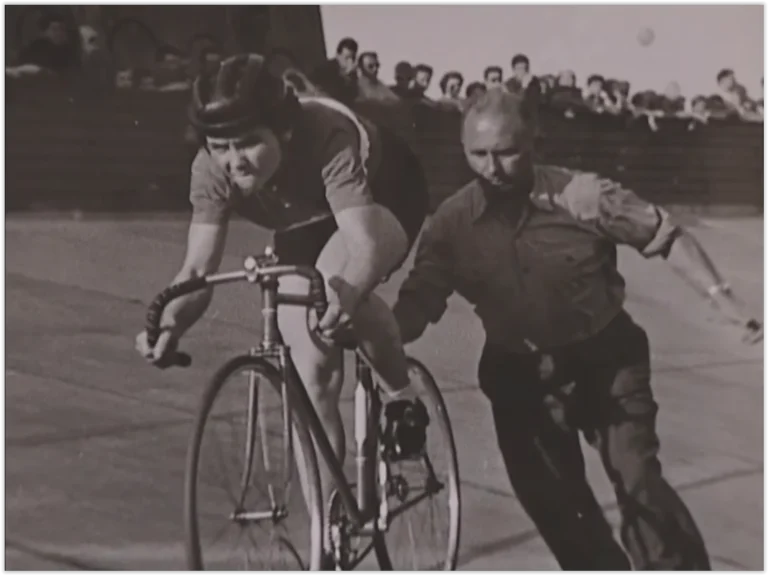
We need to start with the founding father. František Martínek was born in 1903. He practiced athletics for four years and did well, even winning the championship title in the 400 meters. That is why the Grand Prix cycling trophy is shaped like an athlete… However, in 1925, he switched to cycling. He became the Czechoslovakian champion five times (1926 and 1927 in road hill climbing, 1927 and 1928 in track sprinting, 1929 in the 50 km track race). He competed twice in the handicap race at the world championships, reaching the quarterfinals in 1933.
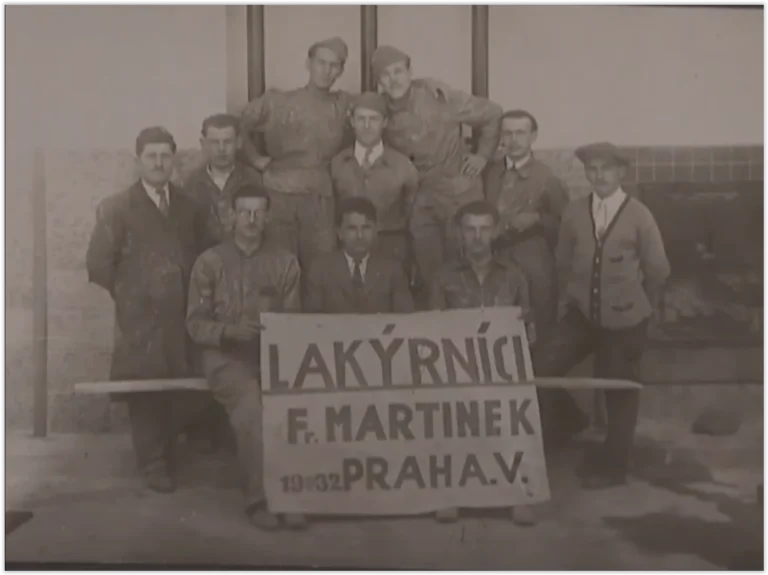
Whether wearing the colors of AC Sparta or SK Slavia, he was always among the best, appearing on the podium almost forty times, sixteen times even on the highest step. After ending his racing career, he applied his skills in another field, following in his father’s footsteps and becoming the owner of the Prague branch of a thriving paint factory. Did you know that Josef Lada also bought from him?
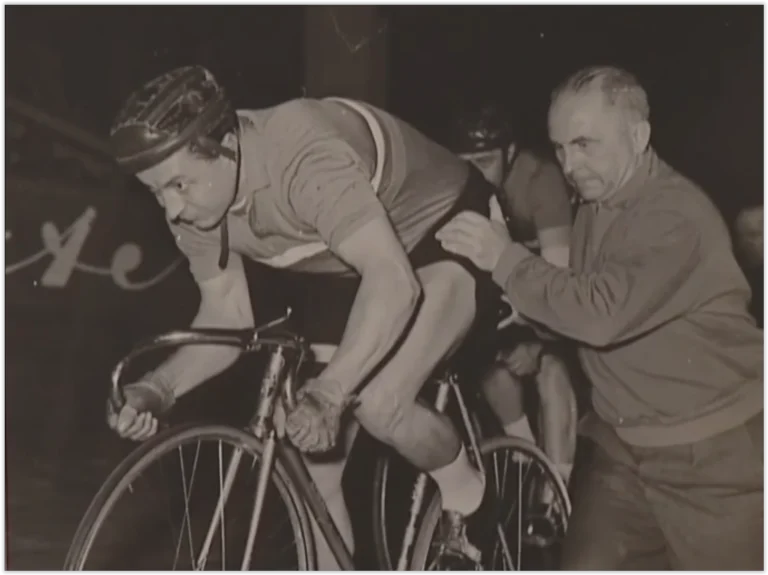
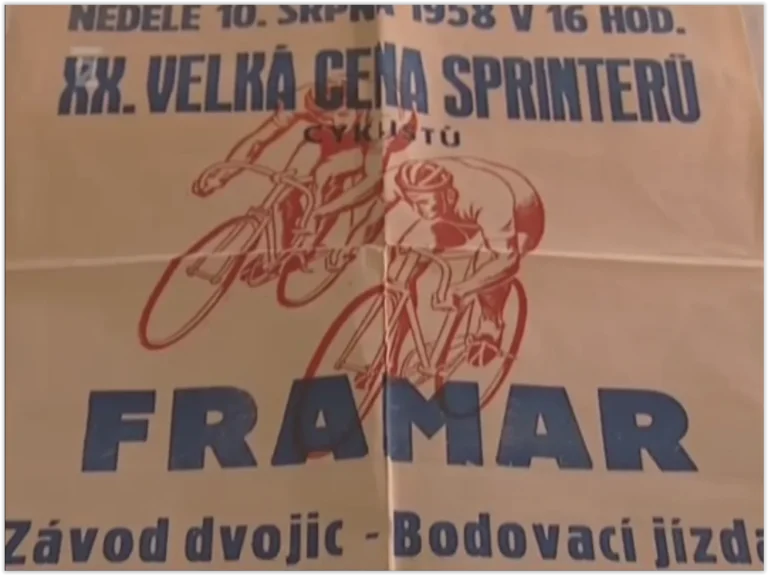
He remained involved in cycling, founding a club and, in 1938, the Framar sprint race. At the beginning of World War II, he also played a major role in the construction of the first velodrome in Třebešín on the site of the former Viktoria Žižkov football stadium. After 1948, the communists stole his factory and he spent a year in the communist camp Barbora. He then devoted himself to the craft of painting in the Barrandov studios and worked as a coach and masseur for leading Czechoslovak cyclists. He spent a lot of time at the famous Ztracenka tramp settlement. He died in 1980.
Ten years later, in a free country, his son Jan Martínek and daughter Monika continued the tradition of the restored company, which is now run by his great-grandchildren Edita and Kryštof Bílkovi. Except for four years (1987, 1992, 1994, and 1995), the Framar Grand Prix cycling race has continued and is once again an integral part of the UCI international track calendar.
First in Žižkov, then by the Vltava River, and finally on the track
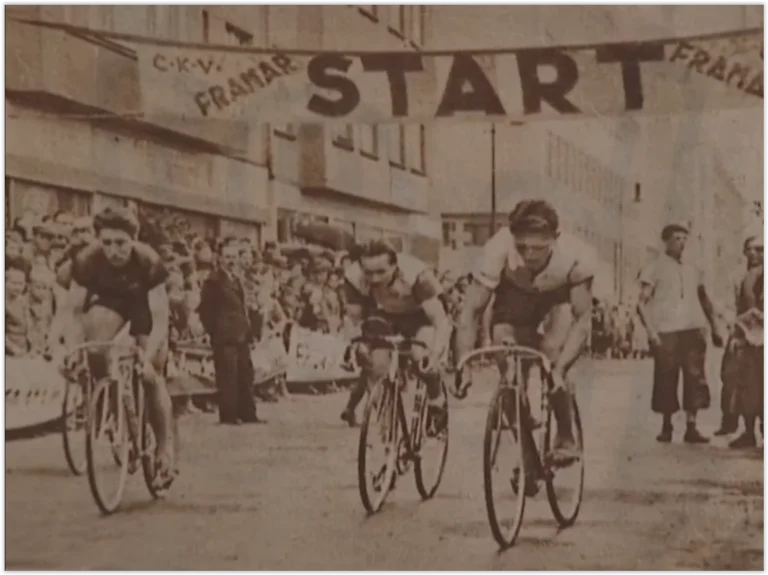
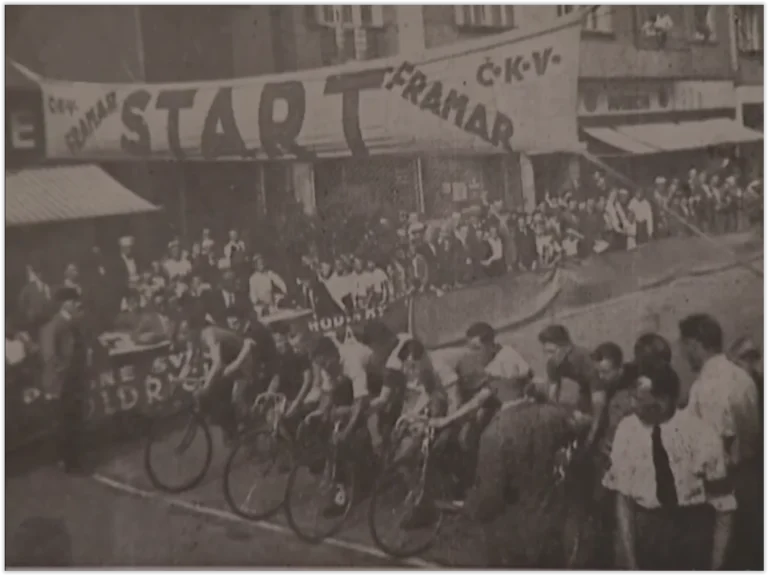
But let’s go back to 1938. “Everyone in the club was very happy that our first cycling race in the streets of Prague’s Žižkov district had gone well. At that time, it was held on a small circuit across tram tracks, which caused the organizers the most concern during operation. The presence of engineer Kaisr, the head of operations, solved this thorny problem. He stopped tram traffic several times by raising his hand, and the individual races were able to pass through. According to the standards of the time, there were quite a few competitors and spectators for the sprint,” recalled František Martínek.
On April 17, Emanuel Kříž from LKBB Prague, more of a pacemaker than a sprinter, won with a time of 37,750 meters in an hour. On July 10, Vilém Jakl Maraňon won. “Only two of the planned eight races took place, because serious times were coming, it was not possible to perform in public on the streets, and war was approaching,” he added.
However, the races brought a breath of fresh air not only to the cycling scene. “It was a novelty, as yet untested, a completely different way of racing over short distances, on a circuit. The cycling track in Letná, Prague, had been demolished and the sprinters were out of work, some even unemployed. That’s why we decided to give them an opportunity in a regular series of short races. We wanted to keep this discipline, which is the queen of track sports, at the top in our country. To give everyone a chance, especially those who grew up as new sprinters,” Martínek wrote.
“Not everyone understood our intention; the new concept of racing did not correspond to the old format familiar from race tracks. But we brought races where spectators had a clear view. The audience watched the start and finish, the whole race, which is the most important thing. A cycling track provides spectators with a perfect view. Without a track in Prague, we tried to maintain the interest of the riders and create a team for the future,” he added.
There was a track 100 kilometers from Prague, in Pardubice, but there were very few races there. Most of the competitors had to get there and back on their own, i.e., by bike, which was an achievement in itself… Naturally, this was reflected in the performance of the sprinters, who were called “airplanes” in the newspapers at the time. There was no specialization, and Martínek himself, as a former sprinter, knew about the consequences of “unemployed” seasons, about the decline of the sport without regular competition. And so, despite all the shortcomings, he at least provided this substitute.
“We were looking for a more suitable track for our races, and in the end we came to the conclusion that the two-way street Na Pankráci, which was relatively undisturbed by traffic, was the most suitable race track. It was paved, wide enough, with a free curve for higher gears and a whole group of riders. These were mostly technical issues that suited the riders so that they could use their racing bikes,” Martínek said of the approximately 800-meter two-lane road in Pankrác.
After the initial shock of the war and the occupation of the Sudetenland had passed, sporting life continued. In 1939, six races were held, each featuring around sixty competitors and watched by up to three thousand spectators. The year-long competition was won by Josef Konárek from AC Sparta, who dominated two events, while Vočka from Framar dominated three and Jakl, also from AC Sparta, dominated one.
A year later, the planned eight races were held, with a total of 500 competitors and 25,000 spectators. Josef Konárek defended his overall victory with three wins, the same number as Mareš from Židenice, and one each for NSK Praha, Sebastian, and Krýsl. Krýsl also set the fastest time over the last 200 meters: 12.2 seconds.
Cycling races also produced some curious moments. “Once, a club official who felt aggrieved in the heat and whose man did not make it to the final stepped up to the starting line with a serious face, raised his hand in disagreement, and loudly declared to all the referees, but mainly to the spectators: He is riding under protest. None of us knew what this gesture meant. There were no racing rules for road sprints. Everything was just provisional, something between the track and the road. Perhaps trust and fairness were supported by my person, I don’t know. We let the boy start from the second row and the result came. The wolf was fed and the goat remained whole,” said the founding father with a smile.
Over time, a tactic developed – whoever started the sprint was at a disadvantage, breaking the air, while the others rode behind him, but he chose the smoothest part of the track surface. A wave in the sprint was punished as obstruction, and the culprit was relegated to last place in the race. It was similar to six-day races on small tracks, where the judge’s observation and judgment were decisive.
In 1941, two races were held on the road on Švehlovo nábřeží near the Vltava River and one on the new NSK concrete track in Malešice. Josef Konárek won the year-long competition again and for the last time. This is how he was remembered: “When the closed group was already racing and he was stuck in the middle with no chance of doing anything, his categorical command rang out: Make way for Konárek! The young men moved aside, such was his respect, and Pepa won…”
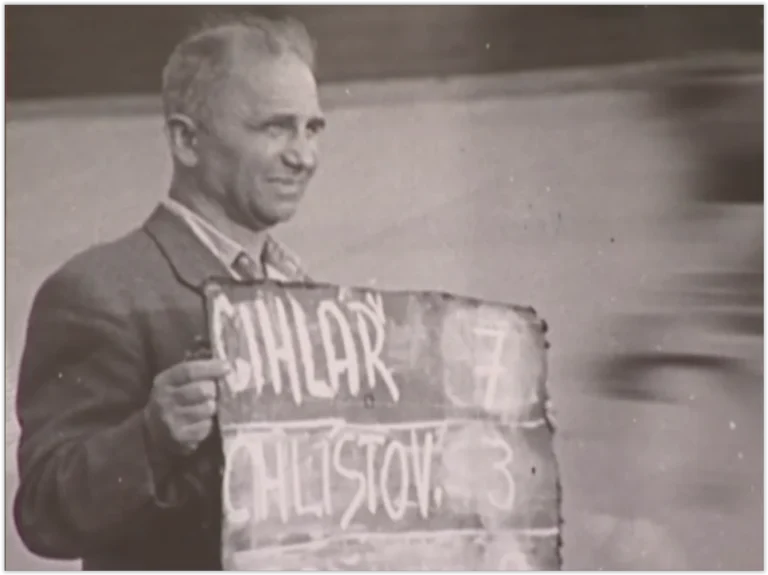
A new generation was already appearing on the Třebešín track in Malešice. Vladimír Vojtěchovský from Slavia won twice, but was later arrested and executed by the Germans… Then Vladimír Čapek and, in the last year of the war, the legendary Jaroslav Cihlář, a great long-distance runner and later an important coach and expert. In 1946, three races were held again, dominated by Cihlář (VSK Praha), who also took on organizational responsibilities in the following years.
We arranged and paid for accommodation for competitors from other parts of the country and recommended restaurants. Everyone paid for their own meals, as they would have eaten at home anyway. The Brno competitors charged for their train travel, while those from Louny and elsewhere arrived by bicycle. The familiar amateur conditions made it easier to organize competitions. The competitors would have come anyway, as they had the opportunity to test their strength and compare their style with the best. They were driven by the natural desire of all young people to excel.
After the races, all the club members gathered at the inn at the finish line and relaxed after cleaning up the improvised stadium. The treasurer ordered two sausages, a roll, and a beer for everyone. The reward was as simple as the whole sporting life. We were dependent only on our own resources. A brief reflection on the results, insights for improving the organization of the next race, and then home. Because the day was over,” Martínek recalled again.
From Cihlář to Kučírek, Tkáč and Morelon…
In 1947, Zdeněk Štěpánek from VSK Praha, a fast and explosive cyclist, won one race, and then the entire competition a year later and again the following year. In the next season, however, both he and Cihlář had to bow to Václav Machka, a “natural” from Pardubice. Cihlář, one of the pioneers of systematic training, finally got his chance in 1951. “It’s one of the pearls in the historical necklace of Czech cycling,” he said.
Then came the era of five amazing victories by Ladislav Fouček from ATK Praha, an explosive and dynamic sprinter who was also skilled at the kilometer with a fixed start. At the 1956 Olympics in Melbourne, he won two silver medals, one in the kilometer and one in the tandem. Unfortunately, at that time, he had no chance to show more on the international scene. After him, Zdeněk Černý, then still a medical student, and Juraj Miklušica from Dukla Pardubice entered the list of winners.
It was not until 1959 that foreign participants appeared, not only from the friendly German Democratic Republic, but also from “western” France, albeit from the workers’ sports organization FSGT. However, none of them could match the already qualified doctor Zdeněk Černý from Brno, Heršpice. The race gained elite international prestige in 1960 with the victory of Jan Lambrechts from Belgium, who was “doubly happy” about this fact. He was followed by Handley from England and the promising Vladimír Novák in third place. The following year, the trophy also moved abroad, to Poland, thanks to Zbygniew Zajac, a World Championship finalist.
After him, Antonín Staněk, the new Czechoslovak record holder in the kilometer (1.065), shone again. A year later, in 1963, came the first triumph of Ivan Kučírek, “a hurricane wasting the excess of his youth,” as Martínek himself called him. The following year, Bruno Gonzato from Italy, later world champion in tandem, reigned supreme. “Here I realized that it’s not only Italy that can organize a big race in a beautiful setting,” he smiled. The next laurels belonged to Jiří Pravečka, perhaps the mildest of all sprinters in character. “The level is rising, with a truly international class coming here,” wrote the newspapers. Jan Kolařík from Dukla Pardubice appreciated the victory all the more.
In 1967, during the reconstruction of the track in Malešice, Prague, the race was held in Louny, with Stanislav Volf winning. The events of 1968 and the Soviet occupation interrupted the history of the Framar Grand Prix for the first time. Two editions were then held in Brno, where the local Ivan Kučírek always reigned supreme. It was not until 1971 that Framar returned home to Třebešín, but with the same winner, Kučírek, who that year won the bronze medal at the World Championships. Then another representative, Miroslav Vymazal, won, who became world champion a year later in San Sebastian, riding in tandem with Vladimír Vačkář. The young men from Dukla Pardubice, Vladimír Popelka and Petr Kocek, dominated the 1973 season.
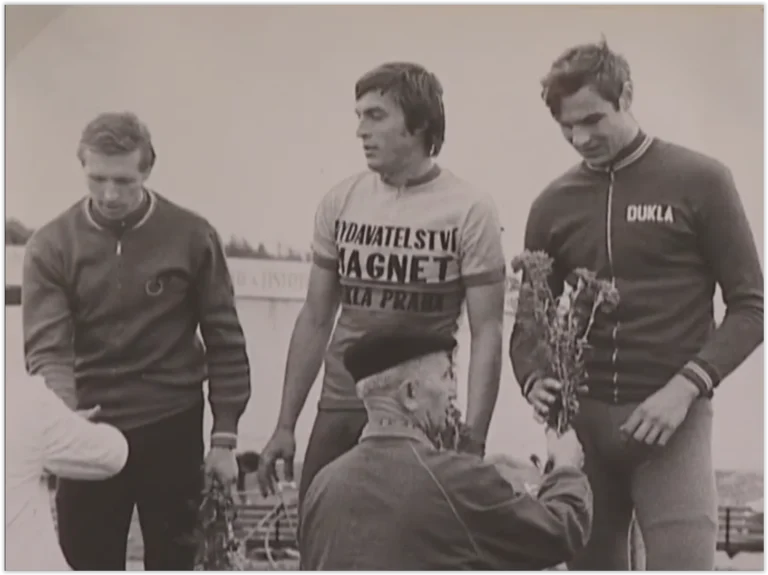
This event was a precursor to the most famous one, which attracted 21 stars from around the world, led by Frenchman Daniel Morelon, who went on to become a three-time Olympic champion and eight-time world champion. It was described as a mini world championship! The well-known German coach Gustav Kilian added: “Such dramatic races are often not even seen there…” Second place went to Australian Nicholson, the runner-up in the Olympic sprint in Munich in 1972, third to Tkáč, fourth to Kučírek, and fifth to Vymazal. Morelon won two of the four races, Tkáč and Nicholson one each. Morelon said with admiration: “It won’t be long before Tkáč wears the rainbow jersey.” He was not mistaken.
The following years in front of the packed grandstand belonged again to Vymazal and Kučírek. A year after winning Olympic gold in Montreal in 1976, Anton Tkáč finally reigned supreme here as well. “I became world champion twice, but Framar only won once, that’s how great the competition used to be here,” he later lamented.
After him, Kučírek, also the 1980 world champion, became the record holder thanks to his sixth triumph at Framar. “It’s my favorite race, where I’ve always found excellent opponents and a lively and knowledgeable audience in the stands,” he praised the organizers.
The list of winners was filled with other big names: Yave Cahard from France, Freddy Schmidtke from West Germany, then Václav Novák, followed by Detlef Uibel (East Germany), Vratislav Šustr, Michael Hübner, and Michael Schulze (both East Germany). “I always thought that the big sprint only took place in Paris. But Prague also belongs to that world thanks to Framar,” explained Cahard, winner of the rainbow jersey and Olympic silver medal.
“My dad remained the soul of the race, even though it was officially run by people from the sports clubs and teams he himself had previously coached. Foreign competitors rode thanks to personal contacts. The race was subsidized by the ČSTV, as it was good publicity for the communist state in the eyes of the world, as with other sports,” recalls Jiří Martínek, the founder’s son, who took over the race in the 1980s. He himself participated in the Grand Prix in the 1950s, but as he says, “I was more of an endurance rider.” He still rides a bike today, even though he is 86 years old.
… after the fall of the Iron Curtain, the keirin champions also won, and Velo d’Or appeared.
The second break came in 1987. A year later, Schulze won again, and during the next reconstruction, Šustr won, this time in Pilsen. In 1990, Markus Nagel raised his hands above his head, after the fall of the Berlin Wall and the Iron Curtain, once again just a “normal” German… The following year, the prize went to Peter Malíček, then to Luboš Hargaš. However, Framar’s fate hung in the balance, with the race not taking place three times (1992, 94, and 95). “After the main organizer, Karel Fuks, died and we were dealing with the return of the company, I didn’t have the capacity anymore,” explains Jiří Martínek.
Thanks to the organizational work of Bohuslav Šára, the race was held four times in an inflatable hall in Motol, where competitors measured their strength in an omnia format, in which Pavel Buráň was the best and Ivan Vrba won three times in a row. At that time, the creation of a sprint week with races in Prague, Brno, Bratislava, and Vienna helped to ensure the race’s continued existence. The Grand Prix returned to Třebešín under the banner of the TJ Kovo club, which still looks after it today. The races were organized by its chairman, Zdeněk Lněnička, while Vladimír Holeček, vice-chairman of the UCI, took care of international contacts.
In 2000, Framar reappeared in the UCI calendar, with Buráň once again winning ahead of the Latvian duo Kiksis-Berzins. This was followed by three Slovakian years, thanks to Jaroslav Jeřábek (twice) and Peter Bazalík. Their dominance was only ended by the indomitable Buráň. Another later world champion, Alois Kaňkovský (in the 2007 omnium), won here in 2005. Foreign domination continued thanks to junior world champion Mark French (Australia) and Matthias John (Germany) twice.
After them, the Czechs took over – Šimon Adámek, David Rais, Jakub Vývoda, Jiří Janošek (twice), Jiří Fanta, and Tomáš Čapek. For six years, the main race was dominated by young riders from the elite sports center in Kovo, thanks to Jaroslava Mixová.
After the return of the “big boys,” Brno’s king of Japanese keirin, Tomáš Bábek, celebrated twice here, and Martin Čechman once. In 2019, the trophy traveled all the way to Taiwan thanks to Nien Hsing Hsieh. The last two Czech names among the best are Jakub Šťastný and David Peterka.
The Grand Prix restored its former glory, and points began to be collected here for the World Championships and the Olympics. That is why foreign faces continued to dominate the top step of the podium – Moritz Malcharek, German silver medalist from the European Championships in scratch, Italian hopeful Mattia Pedromo, Colombian world champion in keirin Kevin Quintero, and most recently Maximilian Dörnbach, German junior world champion from 2013, who won both the sprint and keirin here last year.
The last edition, which was held thanks to a public collection, was graced by the participation of the Velo d’Or winner, currently the best female cyclist in the world, nine-time world champion on the road and track, Lotte Kopecky from Belgium. “I think it was great for the spectators to see such a star here. Some of the girls focused only on her when she appeared, which affected the race a little, but there were three Belgians here with her, so it was great competition for all of us. The velodrome has undergone renovations, the barrier is perfect, and when the weather is good, it’s the best track in our country,” praised the experienced Jarmila Machačová, Czech world champion in the points race in 2013.
“Framar is not just a race. It is a story of Czech sport, tradition, and family heritage. Thanks to unprecedented public support, we were able to once again offer races in the highest UCI Class 1 category,” said Jiří Martínek, son of the race founder, with satisfaction. “For me personally, perhaps the strongest memories remain from the years when we organized a race for young people a few years ago and more than a hundred young cyclists rode here,” he added.
“We have an even better date reserved for May 2026 (May 8-10), and given the rise of women’s cycling, we would like to give equal recognition to the women’s sprint among the Grand Prix winners,” said Marek Mixa, head of the organizers from the local club Kovo Praha.
Tomáš Nohejl